Saturday, August 22, 2015

Armistice Day Remembered


Walter Keller with his five sisters and their mother.


In 1918, Walter Keller was sent overseas as a part of the American forces during WWI. While abroad, Walter was a faithful writer to his five sisters, his mother and his sweetheart. He wrote to each of them unfailingly, describing his experiences in France.
            On November 11, 1918, Armistice Day brought an end to the Great War and Walter was in France to join in the celebrations. On November 19tt, he wrote to his sister Lillian Keller about the experience.

“Dear Lillian,
I am about recovered from the Grand Celebration, so I shall make an attempt to answer two of your letters, one dated Oct. 18, and the other Oct. 23. First I must try to tell you something about the Victory celebration. I had thot that I had seen some celebrations before, but this one eclipsed anything I had ever run across. Champagne flowed like water. Parades of all kinds, some lead by a band, others by nothing more than a French soldier with a horn, or even a fiddle, or rather violin, or even an accordion or mouth organ. French men, women, children, soldiers if all the Allied armies, arms locked across the whole width of the streets. All street cars stopped early in the afternoon, as it was impossible to run them. Old men with long whiskers, young children, hardly old enough to know what it was all about, every one joined in, I kissed, and was kissed by old be-whiskered men, old women, pretty girls, French soldiers, Belgian soldiers, and I do not know what else. I came home or rather back to camp after a while for I gave up all hopes of drinking up all the wine, so do not know how long it lasted, but I suppose it was all night, for I went back down the next evening, and it was still going as strong as ever, and lasted even till the third evening. I wish I could have been in Paris, or some other large place. I do not know how it was there, but if it was anything proportion, I have an idea that I must have been wild, for if a little place like this can put on such as this, I must say that it must have been real in the other places.
We have been having some fine fall weather, with just a touch of winter, for it has been freezing some real ice for some time. Today it is warmer, and cloudy, and looks as if it might rain, I do hope that it will not start to rain again, for I do not like it a bit. I would rather have cold and clear than warm and raining all the time. I had almost begun to think that my photos had not reached you, as I had not heard anything about them, but I see they got there alright. I am rather puffed up with pride at all the comps I received about my appearance. I started to raise a moustache several times, thinking to have my picture taken again, but have never had the heart to do it.
There is little else to write. We hear a lot of rumors as to what we are to do or not to do, but they are all just rumors, and not worth bothering ones head about. I do hope that they will move us to another pace soon, for I am tired of this town and would like a change. This leaves me well as usual. Give my love to all.”
            Thank you to Leona Garrison for sharing this letter, written from her uncle to her mother. This letter was among the many loaned by the community to the Geary County Historical Society for the military exhibit Letters Home, which features letters written from soldiers abroad from the 1880s-1980s. The exhibit will be taken down on September 21st, so stop in soon to see these fascinating letters. The museum is open Tuesday-Sunday, 1-4pm.     


Saturday, August 8, 2015

What are the worst floods in Junction City history?

Junction City gets its name became of its position at the confluence between the Smoky Hill and the Republican Rivers. This naturally puts the city in a very precarious positioning between the two rivers and has seen some devastating effects because of this. There have been quite a few minor floods such as those that occurred in 1903, 1908, 1909, 1915, 1919, 1923, 1927, 1930, 1941, and 2005.  Although each one of these floods has their unique story and history, the three floods that everyone remembers around this are the floods from 1935, 1951 and most recently the flood of 1993.  Each of these three floods caused damage behind, but perhaps most importantly, each one of these floods left behind a major imprint in how the community went forward in dealing with future floods and left behind a multitude of personal stories in the Geary County community. 

One of the first major floods that the area encountered was the flood of 1935 where the Republican River was the main culprit. This flood could be seen as somewhat ironic as it happened during some of the driest conditions ever seen in Kansas during the Dust Bowl Era. The flood of 1935 actually happened two weeks after one of the most devastating day of dust storms, aptly named “Black Sunday”. Black Sunday displaced 300 million tons of topsoil from the prairie area in the US. Most of the flooding occurred because the Republican River in Nebraska had been soaked by rains which started in late May and about June 1st a cloudburst at McCook, Nebraska, sent a wall of water roaring down the Republican River, bringing destruction all the way form the western Edge of Nebraska to Kansas City. The devastating of the 1935 was not just felt in Junction City, but some of the worst flooding occurred in in the areas of eastern Colorado and western Nebraska as this still continues to be some of those areas’ worst flood on record.
This picture was taken after the flood of 1935. As it notes, this taken on East 6th street a day looking towards Grandview Plaza
           

Perhaps the most famous and the most catastrophic of the three major floods in Junction City was the flood of 1951. At the time of the disaster, the 1951 flood was the most severe and widespread on record since the U.S. Geological Survey began its Kansas stream-gaging program in 1895. Its record damage in Kansas and Missouri totaled more than $870 million and saw 19 deaths, including one in Junction City. Locally, Junction City lost $3.5 and Fort Riley accumulated a $6 million loss. The 1951 flood was considered to be the first $1 billion dollar natural disaster in the history of the United States.  Unlike the 1935 flood, the cause of the flood was from both the Smoky Hill and Republican rivers. Both rivers saw record high levels after four inches of overnight torrential rains on July 10th. The flood of 1951 was the first time in 48 years that water from the Smoky Hill River had broken west of the railroad track in east Junction City, an area that evacuated an estimated 3,225 residents. By far, the worst day of the flood was on unlucky July Friday the 13th. It was estimated that some areas of Junction City were under more than four to five feet of water from both rivers. After the floods of 1951, the Flood Control Act of 1954 authorized funding for the Tuttle creek and Milford Dams, which would help to reduce damages in future floods.  For residents of Junction City, that Friday the 13th in 1951 will be a day that will never be forgotten. 

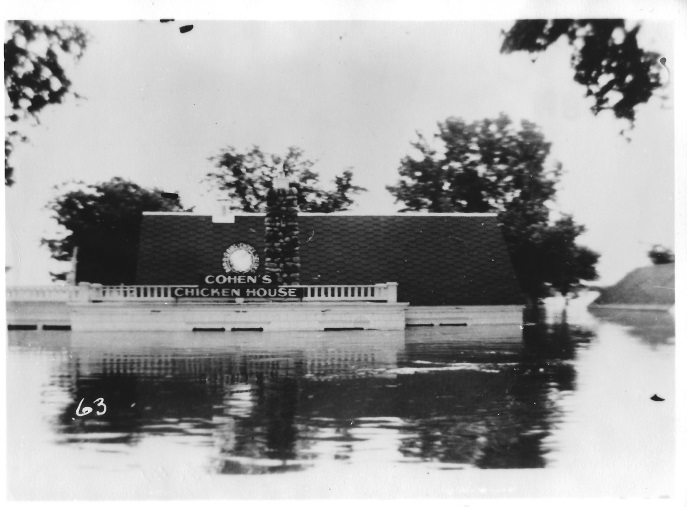
This picture was taken shortly after the flood of 1951. The location was at the old Cohen’s Chicken restaurant on Grant Avenue.

The most recent of devastating floods occurred on Monday July 19th, 1993. The magnitude and timing of several rainstorms in mid-June and July 1993, combined with wet antecedent conditions, were the principal causes of the severe flooding in the upper Mississippi River Basin in 1993. The entirety of the flood spanned nearly 2 months from mid-June to early August. By 11:45 on that that same day the outflow the Milford dam was recorded at 22,500 cubic feet per second, when the usual average release is 10- 12,000 cubic feet per second. The first road to flood was Kansas highway 244 and then Kansas highway 57 followed suit. On the first day of the 1993 flood, 3,000 people were asked to evacuate and only 1,500 took up the offer. As the flood got progressively worse, more and more people were evacuated to shelters. Fifty deaths occurred in all affected areas, except for Kansas, where not deaths were reported. Damages approached $15 billion in the nine-State area of the Midwest.

This was an aerial picture taken in 1993 of rural area being devastated by the flood.


Each one of these past floods have left a unique imprint on the history of Geary County and shaped the lives of many of the citizens who have lived in the county. Unless Junction City moves location and changes its name, floods will continue to be a very important part of its past and perhaps its future. There is no way to predict any upcoming floods and we hope that the Milford and Tuttle Creek dams can do their job and prevent any future floods. But as we learned from the past, this community is resilient and can overcome any flood. have any comments of question? Comment down below and follow us on Facebook !

Tuesday, August 4, 2015

100 years of Waters Hardware

This past May, Waters True Value Hardware celebrated their 110th anniversary of having a store located in Junction City. Along with having a store in Junction City, Waters Hardware has expanded to six other cities and have stores located across the state in Dodge City, Great Bend, Salina, Emporia, Manhattan, and Wamego. Before there were seven stores there was just one. The first store had some very humble beginnings in Manchester, Kansas and during the turn of the century, the original founder, G.E. Waters, made the transition from Manchester to Junction City.  Since the original Waters owner, the store has now seen six generations of Waters running the store and this tradition doesn’t seem to be slowing down anytime soon. The Waters Hardware store is a Junction City tradition, and it is one of the staples of this community.

            The original founder of the first Waters store was George Edwards Waters, also known as G.E. Waters, who was born in Northfield, Minnesota in 1860. As a child, G.E. and his carpenter father moved to Knoxville, Tennessee to try and capitalize on the rebuilding effort in the south after the Civil War. During his time in Knoxville, G.E. attended Eastern Tennessee University where he played baseball. It is interesting to note that while at Eastern Tennessee University, G.E. waters played against the hall of fame baseball player, Ty Cobb. After college, G.E. Waters was able to get into the hardware business due to a family favor. G.E. Waters was a manufacturer’s representative and was called to Burlington, Kansas around 1887 to help an aunt operate a family hardware store until her son, Frank Haight, was old enough to take over the helm. Waters ran that store until 1889. A few years later, Waters left Burlington and opened up the original Waters Hardware store in Manchester, Kansas in 1902.

G.E. Waters was pulled away from Manchester for one reason: better education for his children. In 1903, a new high school was built in Junction City (where the Geary County Historical Society is currently located today), and Mr. Waters wanted to send his children there to get a better education. Both of his sons, Clarence and David, enrolled as freshmen at the high school. This decision moved the Waters family from Manchester, Kansas to Junction City. But not only did G.E. decide to move his family to Junction, he also decided to move the family business to Junction City.  The first original location of the Waters Hardware store was at the old Masonic building at 722 North Washington. The building use to belong to the Gretner family who owned their own Hardware store, but sold it to G.E. when the Waters family moved into town. In 1917, after a few years in its first location G.E decided to move the family business to the corner of eight and Washington, where the old Cole’s department store was located.

In February of 1918, G.E. Waters passed away in California. Since both of his sons, Clarence and David, grew up working at their father’s store, it made sense for them to take over the family store, so they both worked together to keep the store open. After David and Clarence, their sons, Bob and Wayne took over the business. Wayne left the business to start his own furniture store, which left Bob as the sole Waters in charge. After Bob, his son, Jim Waters, officially entered the family business upon graduating from KU in 1972. The Waters hardware store has truly been a family affair.

During the latter half of the 20th century, the Waters store saw a growth to their business. Bob and Jim opened a hardware store in Salina on August 1973 with Jim as the Manager. These stores, as well a store in Manhattan were helping spread the Waters hardware store around Kansa. Along with the opening of new stores, the Waters Store in Junction City finally decided to make the move from the old building on eight and Washington moved to its current location in 1991 and expanded to include a full lumber yard in 2002. And the last major expansion to the store happened last year when the store saw an expansion of about 37 percent more space.


What does the future hold for this vital hometown company? It looks as though the tradition of family owned will continue. Jim’s son Scott was elected Vice President in 2010 and it looks like he might be the next in line. The Waters Hardware store has been a historical stable in this community for over 100 years, and we can’t wait and see what they have in store for the next 100 years. The Waters family has always been a great supporter of the Geary County Historical Society. They have donated an incredible amount of great artifacts to the museum, specifically the Native American artifacts we have on display in our Native American exhibit. If you want to come check it out, or any of our exhibits, feel free to stop by Tuesday through Sunday between 1 and 4 PM.